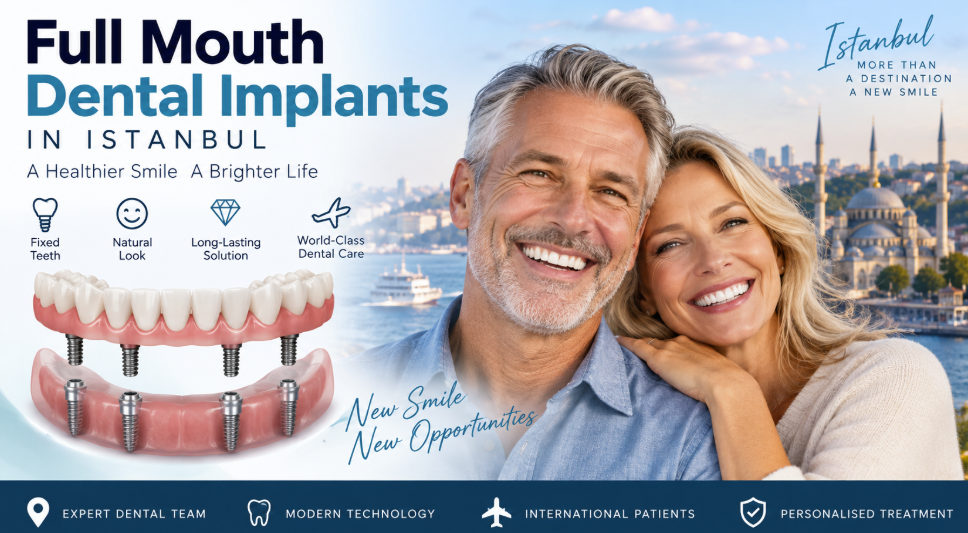
Full Mouth Dental Implants in Istanbul – Complete Treatment Guide
Losing most or all of your teeth can affect much more than the appearance of your smile. Missing or severely damaged teeth may make eating difficult, change speech, reduce confidence and affect everyday comfort. For patients who need extensive tooth replacement, full mouth dental implants in Istanbul may provide a fixed alternative to conventional removable dentures in suitable cases.
Full mouth implant treatment does not necessarily mean placing one dental implant for every missing tooth. Modern implant dentistry can use strategically positioned implants to support a fixed bridge replacing an entire dental arch. Depending on bone structure, oral health and the individual treatment plan, options may include All-on-4, All-on-6 or other full-arch implant-supported restorations.
For international patients considering dental implants in Turkey, understanding the complete process is important before booking flights or choosing a treatment package.
This guide explains full mouth dental implants, treatment stages, implant numbers, temporary teeth, healing, bone grafting, recovery and the questions patients should ask before travelling to Istanbul.

What Are Full Mouth Dental Implants?
Full mouth dental implant treatment is designed to replace multiple missing, failing or non-restorable teeth using dental implants that support fixed or removable prosthetic teeth.
A dental implant is typically a titanium fixture placed into the jawbone. After appropriate healing, implants can support dental restorations such as crowns or bridges.
In a full-arch case, several implants are positioned across the jaw to support a complete set of replacement teeth.
Treatment may involve:
- The upper jaw
- The lower jaw
- Both upper and lower jaws
When both arches require treatment, the procedure is often described as full mouth rehabilitation with dental implants.
The exact treatment should always be based on clinical and radiographic examination rather than selecting a standard package before assessment.
Who May Need Full Mouth Dental Implants?
Full mouth implant treatment may be considered for patients who have lost many teeth or whose remaining teeth have a poor long-term prognosis.
Potential candidates can include people with:
- Multiple missing teeth
- Severely damaged or broken teeth
- Advanced tooth decay
- Failing crowns and bridges
- Severe periodontal damage
- Unstable removable dentures
- Teeth that cannot predictably be restored
- Significant difficulty chewing because of missing teeth
However, having damaged teeth does not automatically mean they should all be extracted.
Whenever appropriate, preserving healthy natural teeth should remain an important consideration.
A dentist needs to evaluate which teeth can reasonably be maintained and which may require extraction before recommending full mouth implant treatment.
Full Mouth Dental Implants vs Dentures
Traditional removable dentures rest on the gums and can be removed by the patient.
Implant-supported restorations use implants placed within the jawbone to provide additional support.
A fixed full-arch implant bridge is designed to remain in place during normal daily use and is removed professionally when required rather than being taken out every night like a conventional denture.
For suitable patients, a fixed restoration may offer improved stability when eating and speaking.
However, implant-supported teeth still require careful cleaning and maintenance. They are not maintenance-free replacements for natural teeth.
The choice between conventional dentures, implant-retained dentures and fixed implant bridges depends on anatomy, general health, oral condition, expectations and other clinical factors.
How Many Implants Are Needed for a Full Mouth?
One of the most common questions about full mouth dental implants in Istanbul is how many implants are required.
There is no universal number.
An entire dental arch may sometimes be supported by four implants, as in an All-on-4 concept. Other treatment plans may use six or more implants depending on bone availability, prosthetic design and clinical requirements.
If both jaws are being treated, the total number of implants will consequently be higher.
The dentist considers factors including:
- Available bone volume
- Bone density
- Jaw anatomy
- Location of anatomical structures
- Bite forces
- Opposing teeth
- Planned bridge design
- General health
- Smoking history
- Previous dental treatment
A CBCT scan is commonly used in implant planning because it provides three-dimensional information about the jawbone and surrounding structures.
All-on-4 Dental Implants
All-on-4 dental implants describe a treatment concept in which a full-arch prosthesis is supported by four implants.
The implants are positioned strategically within the jaw. In certain cases, posterior implants may be angled to make use of available bone and support the planned restoration.
All-on-4 can be considered for selected patients who require replacement of most or all teeth in one arch.
However, four implants are not automatically appropriate for every patient.
Bone quality, anatomy, bite and other individual factors must be assessed before the dentist recommends this approach.
All-on-6 Dental Implants
An All-on-6 approach generally uses six implants to support a full-arch restoration.
Using additional implants can provide different options for distributing forces across the restoration, but this does not mean that six implants are automatically better than four in every situation.
The appropriate number depends on t


